Introduction: Deals Don't Stall in Meetings. They Stall Between Them.
Most B2B deals do not lose time in the discovery call or the demo. They lose it in the gaps: the two days before a lead is researched, the week a proposal waits for pricing approval, the follow-up that slips because the rep was in back-to-back meetings. Every gap is friction, and friction is where pipeline velocity dies.
The constraint is capacity. Salesforce's latest State of Sales research, a survey of 4,050 sales professionals, finds the average seller spends just 40% of their time selling. The other 60% goes to research, data entry, internal approvals and coordination: precisely the work that sits between buyer conversations.
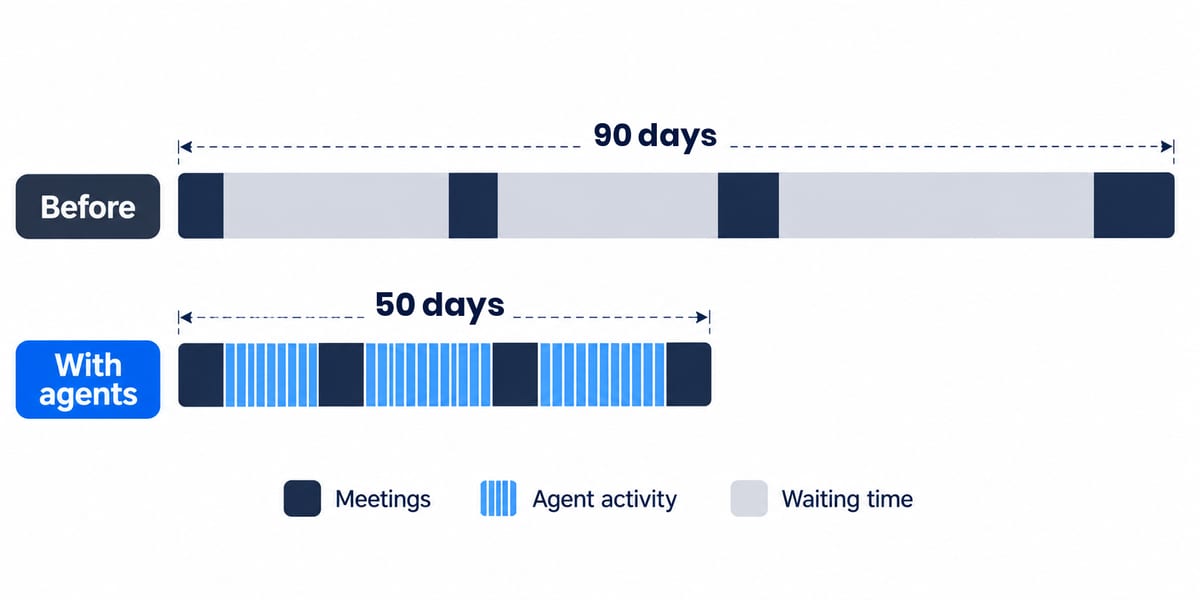
Autonomous AI sales agents are built for that 60%. Unlike earlier automation, they do not wait for a rep to click "send". They research, draft, follow up, update the CRM and route the next step on their own, within rules RevOps defines. When those gaps close, the elapsed time of a deal can shrink sharply, even if the number of meetings stays the same.
This guide is for CROs, VPs of Sales and RevOps leaders who want the operational detail, not the hype: what agents actually do, where the time savings come from, what the evidence says, and how to deploy them without creating what Gartner calls "agent sprawl".
What Are Autonomous AI Sales Agents?
Autonomous AI sales agents are AI systems that pursue a defined sales goal, such as qualifying an inbound lead or preparing a renewal quote, by planning and executing multi-step tasks across CRM, email, calendar and data tools, without a human triggering each step. They act within guardrails set by RevOps and hand off to a seller when judgment, negotiation or relationship work is needed.
The distinction from earlier tools matters, because each category removes a different kind of friction:
| Capability | Rules-based automation | AI copilot | Autonomous AI sales agent |
|---|---|---|---|
| Trigger | Fixed rule or schedule | A rep's prompt | A goal or signal (new lead, stalled deal, renewal date) |
| Handles exceptions | No; breaks on edge cases | Suggests, rep decides | Reasons through them within policy, escalates the rest |
| Works across tools | Single workflow | Usually one app | Chains CRM, email, calendar, CPQ and data sources |
| Runs without a rep | Yes, but only the scripted path | No | Yes, for approved actions |
| Typical example | Sequence sends email 3 on day 5 | Drafts an email when asked | Researches account, writes and sends tailored follow-up, books the meeting, logs it |
In short: automation follows a script, a copilot answers a question, and an agent owns an outcome. That shift, from "tell me" to "do it for me", is what makes agentic sales workflows relevant to deal velocity rather than just individual productivity.
How Do AI Agents Reduce Deal Cycle Duration?
AI agents reduce deal cycle duration by removing the waiting time between buyer interactions: they respond to leads instantly, prepare research and proposals in minutes, follow up on schedule, and route approvals without manual hand-offs. The meetings stay; the dead time around them shrinks.
Sales velocity makes the effect concrete:
Sales velocity = (Qualified opportunities × Win rate × Average deal size) ÷ Sales cycle length (days)
Cycle length is the denominator, so it is the most sensitive lever. A team with 100 opportunities, a 25% win rate and a US$40,000 average deal on a 90-day cycle generates about US$11,100 of pipeline value per day. Cut the cycle to 50 days and, with nothing else changing, velocity rises to US$20,000 per day, an 80% increase.
Where agents take days out of the cycle:
- Speed to lead: inbound leads are researched, qualified and answered in minutes, around the clock, instead of waiting for the next SDR shift.
- Research and preparation: account briefs, stakeholder maps and meeting prep are assembled before the rep opens the CRM.
- Follow-up latency: recap emails, next-step confirmations and content requests go out the same day, every time.
- Quoting and approvals: pricing agents build compliant quotes and route exceptions to the right approver, rather than waiting in an inbox.
- Hand-offs and data: call notes and next steps are logged automatically, so SDR-to-AE and AE-to-CS transitions do not restart discovery.
What the Evidence Actually Shows
The strongest data shows agents cutting the time spent on specific sales tasks by a third to a half or more; whole-cycle reductions depend on how much of your cycle is waiting time and how deeply workflows are redesigned. Here is what the major research says, as of November 2026:
| Source | Finding | What it means for RevOps |
|---|---|---|
| Salesforce State of Sales 2026 (4,050 sales pros, Aug–Sep 2025) | Sellers spend 40% of time selling; 54% have used agents; they expect agents to cut prospect research time by 34% and email drafting by 36% | The biggest capacity gains sit in pre-meeting and follow-up work |
| Salesforce State of Sales 2026 | 51% of sales leaders with AI say disconnected systems slow their AI initiatives | Data integration is the gating factor, not the model |
| McKinsey, July 2026 (B2B Pulse Survey, ~4,000 buyers and sellers) | Agentic AI in even one end-to-end workflow can free about 10% of seller time; one tech company cut onboarding from ~3 months to 6 weeks | Value comes from rewiring whole workflows, not adding tools |
| McKinsey, July 2026 | Fewer than 10% of organizations have scaled AI in any given function | Most teams are still early; advantage is still available |
| Gartner, July 2026 | By 2028 agents will outnumber sellers 10 to 1, yet fewer than 40% of sellers will say agents improved productivity | Deploying more agents is not the same as removing friction |
| Gartner, July 2026 | CSOs who overhaul data, automation and user experience will be 5x more likely to gain ROI from AI | Infrastructure first, agents second |
So, "nearly in half"?
Halving a sales cycle is achievable where most elapsed time is waiting, not deciding: inbound-led, mid-market and renewal motions with clear pricing. The velocity maths above shows why the gains compound. Complex enterprise deals with long legal and procurement stages will see smaller whole-cycle cuts, even when the agent-owned steps shrink dramatically. Treat "nearly in half" as the ceiling for well-instrumented, redesigned workflows, and measure your own baseline before promising it to the board.
Agentic Sales Workflows by Pipeline Stage
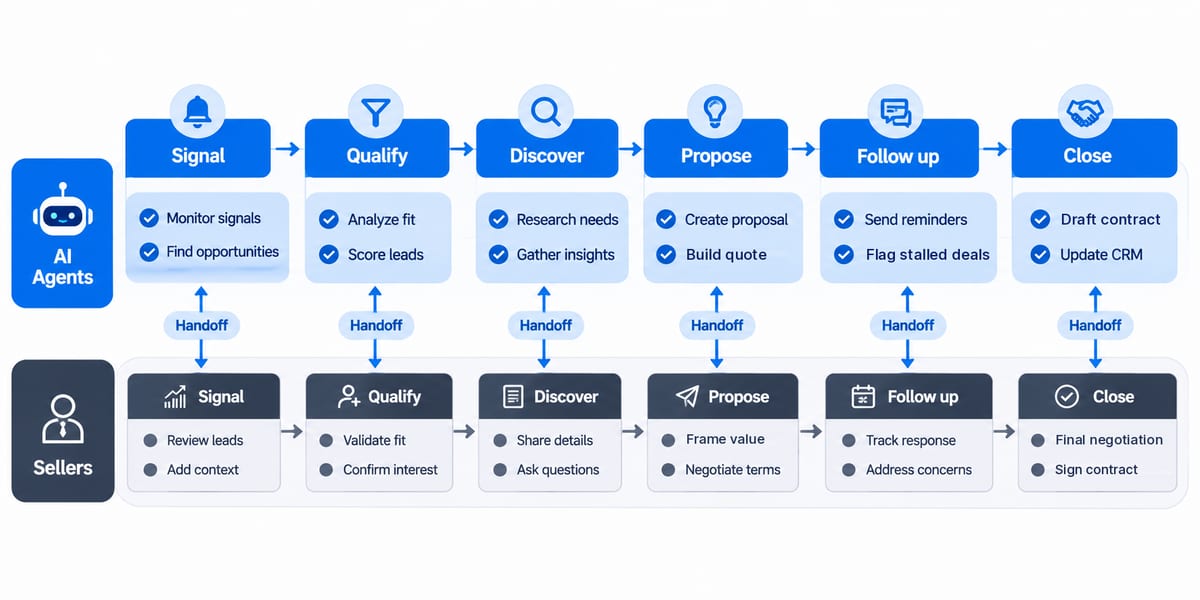
The best agentic sales workflows split each stage into what an agent can own end to end and what a human must own, then make the hand-off explicit.
| Pipeline stage | What the agent owns | What the seller owns | Friction removed |
|---|---|---|---|
| Signal and prospecting | Monitors intent, hiring, funding and news signals; builds account briefs; scores fit and timing | Chooses which accounts to pursue personally | Days of manual research |
| Inbound qualification | Responds within minutes, asks qualifying questions, books meetings with the right rep | Discovery call | Lead decay while waiting for a reply |
| Discovery and meetings | Prepares briefs, captures call notes, extracts pain points, objections and next steps into the CRM | Running the conversation, building trust | Prep time and lost context |
| Proposal and pricing | Drafts proposals, builds quotes within price policy, routes exceptions to approvers | Value framing, negotiation | Approval queues and quote rework |
| Follow-up and mutual action plan | Sends recaps, chases stakeholders, flags stalled deals and missing champions | Multi-threading, executive alignment | Silent weeks between meetings |
| Close and hand-off | Assembles contract packets, compiles onboarding context for CS | Final negotiation and signature | Re-discovery after close |
Two design rules keep this working. First, give each agent a single, measurable job; one "super-agent" that does everything is hard to govern and harder to debug. Second, low-value segments can run agent-led end to end, while high-value accounts keep agents in a support role. McKinsey's research describes exactly this split: agents conduct outreach and nurture for lower-tier opportunities, and act as copilots on strategic accounts.
RevOps Agentic AI: The Operating Model Behind the Agents
RevOps owns the system agents run on: the data they read, the rules they follow, the actions they may take and the metrics that judge them. Without that layer, agents scale whatever mess already exists. As Gartner's analysts put it, fragmented systems lead agents to scale the fragmentation.
Four components make up a workable RevOps agentic AI model:
- A unified context layer. One governed source for accounts, contacts, opportunities, product, pricing and interaction history. Agents fed partial context produce confident but wrong outputs.
- An action policy. A written list of what each agent may do on its own (send a follow-up, book a meeting), what needs approval (discounts, contract terms) and what it must never do (commit to delivery dates, change pricing tiers).
- Human-in-the-loop checkpoints. Defined escalation triggers, such as deal size, sentiment, competitive mention or legal language, that route work to a named owner with full context.
- Observability. Logs of every agent action, outcome and override, reviewed weekly, so errors are caught as patterns rather than customer complaints.
This is also an organizational change, not just a tooling one. McKinsey notes that companies may need to spend about US$3 on change management for every US$1 spent deploying AI, and that new roles such as AI workflow designers and agent managers are emerging inside commercial teams.
If you build some agents in-house, for example as n8n workflows or a self-hosted OpenClaw assistant, they need an always-on server with logging and access control. Our AI Automation VPS plans and the guide to running AI automation bots on a VPS cover sizing, costs and security for that setup.
A 90-Day Rollout Plan for AI Sales Automation
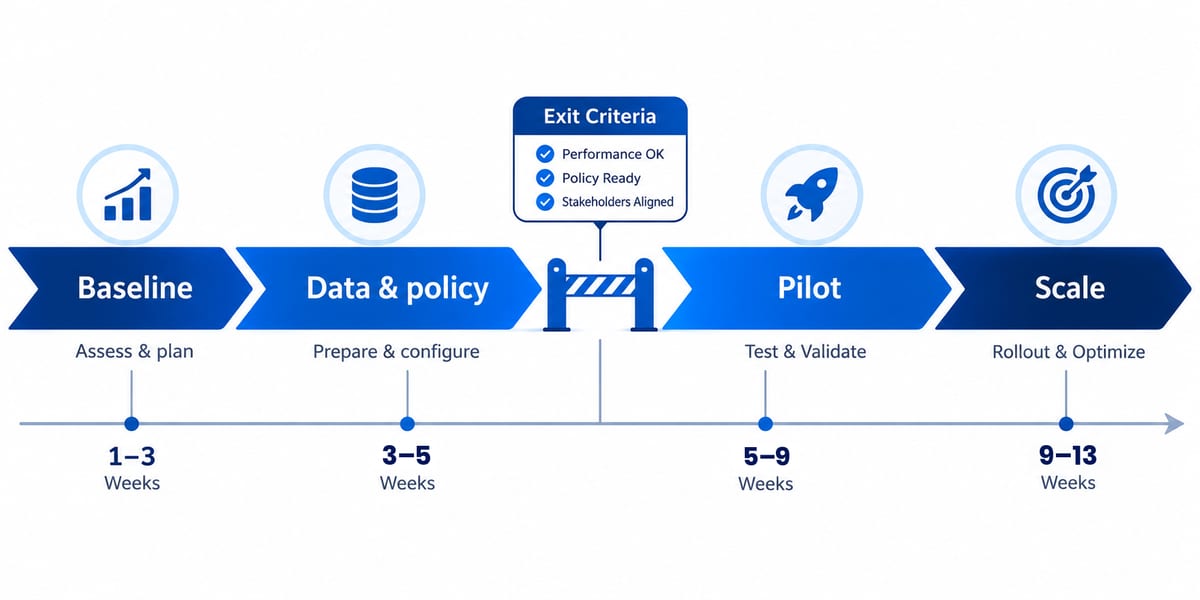
Start with one high-volume, low-risk workflow, prove a cycle-time gain against a baseline, then expand. A phased plan keeps risk contained and gives finance a number it can trust.
| Phase | Weeks | Key actions | Exit criteria |
|---|---|---|---|
| 1. Baseline and select | 1–3 | Measure current cycle length by stage and segment; map where deals wait; pick one workflow (inbound qualification or post-meeting follow-up is usually best) | Stage-level baseline agreed with finance |
| 2. Prepare data and policy | 3–5 | Clean the CRM fields the agent depends on; write the action policy and escalation rules; set up logging | Agent can read complete records; policy signed off by sales and legal |
| 3. Pilot | 5–9 | Run the agent on one segment or team, with a comparable control group; review every escalation weekly | Measurable gain in time-in-stage versus control, error rate within tolerance |
| 4. Scale and redesign | 9–13 | Extend to more segments; redesign rep roles and comp around the freed capacity; add the next workflow | Velocity improvement visible in pipeline reporting, not just activity counts |
The control group matters. Without it, a seasonal upswing or a new product launch will be credited to the agent, and the next budget conversation will be harder.
Metrics That Prove B2B Deal Velocity Gains
Measure agents on time removed from the cycle and on revenue outcomes, not on activity volume. Emails sent and meetings booked go up easily; the question is whether deals move faster and close at the same or better rates.
| Metric | What it tells you | Watch for |
|---|---|---|
| Speed to lead (minutes) | How fast inbound demand is engaged | Fast but low-quality replies that hurt conversion |
| Time in stage (days) | Where waiting time is shrinking | Gains in one stage hidden by delays in another |
| Sales cycle length (days) | Whole-cycle effect by segment | Mix shift toward smaller deals flattering the average |
| Stage conversion and win rate | Whether speed costs quality | Win rate falling as volume rises |
| Sales velocity (US$ per day) | Combined effect of all four levers | Single-quarter noise; track a rolling average |
| Seller selling time (%) | Whether freed capacity reaches buyers | Time saved absorbed by internal meetings |
| Agent override and escalation rate | Trust and accuracy of agent actions | A rising rate signals data or policy problems |
This mirrors McKinsey's advice to link behavior metrics, such as acceptance of AI recommendations, to leading indicators like pipeline velocity, and then to lagging outcomes such as margin and closed-won revenue.
Where Autonomous Agents Fail, and How to Avoid It
Most agent failures come from poor data, unclear boundaries or measuring the wrong thing, not from the AI itself.
- Agent sprawl. Dozens of point agents from different vendors, each with partial context, add noise for sellers and buyers. Fix: a single agent inventory owned by RevOps, with one job per agent.
- Dirty CRM data. Agents act on what the CRM says; duplicates and stale fields produce wrong outreach at scale. Fix: clean the fields each agent relies on before launch.
- Over-automating strategic accounts. Buyers in large deals notice generic, machine-written outreach. Fix: keep agents in a support role above a deal-size threshold.
- Compliance and brand risk. Autonomous email and pricing actions can breach consent rules or discount policy. Fix: hard limits in the action policy, plus legal review of outbound templates.
- Vanity metrics. Activity counts rise while win rate falls. Fix: the metrics table above, with a control group.
- Seller resistance. Reps who do not trust agent output will redo the work. Fix: involve top performers in designing prompts and hand-offs, and show them the time they get back.
Conclusion: Velocity Is a System, Not a Tool
Autonomous AI sales agents shorten deals by attacking the waiting time between buyer conversations, the 60% of seller time that is not selling. Where that waiting time dominates, cycles can shrink by close to half and velocity can nearly double. Where it does not, the gains are smaller but still compound across every stage.
The teams that capture this are not the ones with the most agents. They are the ones that baseline honestly, clean their data, write clear action policies, pilot against a control group, and redesign seller roles around the time they win back.
Next step: pick one workflow this quarter, measure its time-in-stage today, and run a six-week agent pilot against a control group. The baseline you set now is what will prove the result to your board.